Sen. Brisport goes to bat, on video, to enforce Atlantic Yards affordable housing penalties. (What about Dem. Mayoral nominee Mamdani?)
State Sen. Jabari Brisport, a Democratic Socialist who represents the Atlantic Yards site, has--like some of his generational cohort (notably Assemblymember and Democratic Mayoral nominee Zohran Mamdani)--concluded that upbeat but punchy short video, with snappy graphics, might be the best way to communicate.
"New York State just announced they won't collect millions of dollars in fines from a real estate developer that was supposed to go towards affordable housing," Brisport leads off. "And the full story is even more outrageous."
After all, not everyone reads Gothamist, the publication that's most prominently reported on New York State's (via Empire State Development, or ESD) failure to enforce the $1.752 million/month in penalties for the unbuilt Atlantic Yards affordable housing, much less my reporting in this blog (or my newsletter).
UPDATE: 3 months past due, the penalties are over $5M, owed to the people of NY. Let Gov. Hochul know you want to see them stand against private real estate failures.
— Jabari Brisport (@JabariBrisport) August 29, 2025
A big thank you to all the activists, advocates and journalists that have documented this billion dollar mess! pic.twitter.com/GMrExhgKMT
It ends with a link to this petition, from the coalition BrooklynSpeaks, calling on Gov. Kathy Hochul to enforce the penalties.
Setting it up
Let's go through the script of a short, 82-second narrative that gets the high points but, unsurprisingly, avoids some nuance.
"I'm standing outside of Atlantic Yards, a $6 billion mega development project. When the Atlantic Yards deal was announced in 2003, New York offered massive financial giveaways to real estate developers," he continues.
The irony, in retrospect, is that those giveaways--at least when the ownership of the arena company and the Brooklyn Nets was decoupled from the real-estate project--were not enough to make Atlantic Yards financially viable, though the developer insisted, backed by state officials, that the plan would work.
The big winners have been those owners--first Mikhail Prokhorov, then Joe Tsai--taking advantage of the rising tide of value in the NBA, with no obligation to cross-subsidize the rest of the project.
Note that Brisport, who has supported the work of BrooklynSpeaks, which in 2014 negotiated the affordable housing penalties, echoes that group's call for enforcement, while Mamdani has been surprisingly cautious.
(Psst, Mr. Mamdani: You want to make a splash? Go after the tax exemptions for all the city's sports venues, starting with Madison Square Garden.)
Promises, promises
"In exchange, the community was promised 2,250 affordable apartments." Brisport continues. "Decades later, almost half of those affordable apartments still haven't been built."
As the graphic indicates, 876, or 39%, of 2,250 promised affordable units remain to be built.
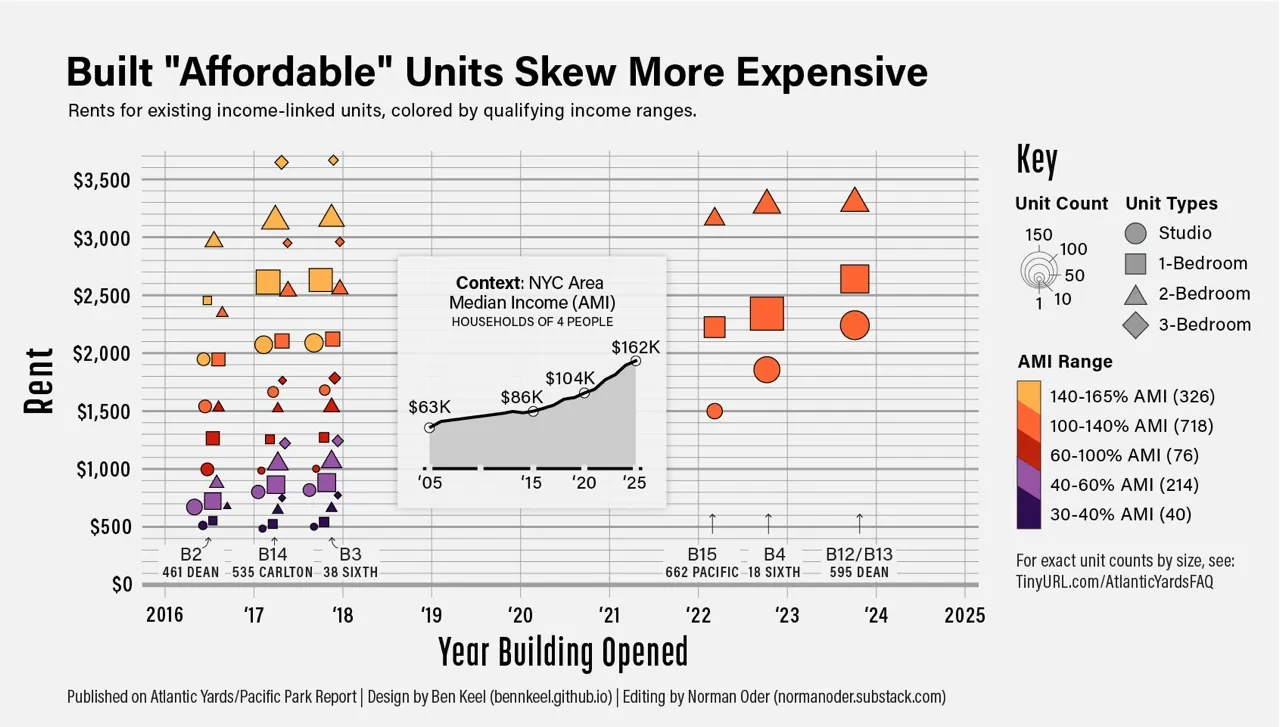
Unmentioned: the state agreed to allow a loose definition of "affordable," which meant, as delivered, the below-market apartments are skewed to middle-income households, hardly those most in need.
"In 2014, community activists forced a legal agreement," Brisport continues. "If the developer failed to build the affordable housing by May 2025, they'd have to pay a monthly fine into an affordable housing fund for each unit they failed to build. Today, these fines amount to $1.75 million per month."
"But here's the catch," he says. "ESD, the state body overseeing the project, is refusing to collect the fines because the developer threatened to sue if they did."
As I wrote, developer Greenland USA might have a partial case for Unavoidable Delay, but ESD should have come clean sooner and seems wary of exercising its significant leverage on Greenland and also arena operator BSE Global, especially given how the court system typically defers to the state.
In other words, ESD's wimping out.
The big picture
"As outrageous as this is, Atlantic Yards is not an outlier," Brisport continues. "It's just a notable example of a consistent pattern: pouring public money into private real estate corporations is, at worst, a scam and, at best, a recipe for failure."
"We need a different model: housing built by the people for the people. This model, social housing, creates affordable housing permanently with community ownership and control. What would you do with $1.75 million a month to fund affordable housing?"
That $1.75 million a month is supposed to go to a city housing trust fund to support affordable housing now, not in some distant future.
As to the alternate model, well, even government intervention for social housing doesn't avoid heavy financial pressure, as indicated in two books I recently read: Jonathan Tarleton's Homes for Living: The Fight for Social Housing and a New American Commons and Annemarie Sammartino's Freedomland: Co-op City and the Story of New York, both about projects developed under New York State's oft-invoked Mitchell-Lama program.
Supporting affordable housing isn't cheap. Mamdani's plan would require the state to lift a cap on the city's bonding capacity and, more importantly, require a reset of common assumptions--among the city's leading elected officials and power brokers--about letting the private sector lead.
If the public sector should take the lead, it has to develop a lot more capacity to do so. Right now, as the Atlantic Yards example shows, it can't enforce an agreement that seems straightforward and a deadline it once insisted it would uphold.
Comments
Post a Comment