At 38 Sixth tower, new troubles: flooding leads to apartment damage, elevator outage; landlord Avanath pursues, then retracts, illegal lease riders
 |
| Looking northwest toward 38 Sixth, at Sixth Ave. & Dean St. Photo: Norman Oder |
About a year ago, I reported for City Limits (link) on persistent complaints about poor conditions and procedures at “100% affordable” 38 Sixth Avenue (B3), a 23-story, 303-unit tower flanking the Barclays Center.
Since then, there have been improvements; the hot water's become more consistent. (Outages still occur; city records show complaints on eleven days between April 1 and June 3.) Intercoms have been fixed, and the front door now closes, though residents say patchwork is evident.
A lawsuit from the 38 Sixth Avenue Tenants Association (TA) led to a consent order last December, in which the landlord agreed to address roaches, fix intercoms, and make key fobs available and functional.
Also, ongoing tensions between management and tenants were reflected in Avanath’s attempt--presumably to enhance its bottom line--to force tenants to sign lease riders agreeing to mandatory arbitration, to desist from any class-action lawsuit, and to have renter’s insurance.
Only after Avanath was informed—by state officials and the tenants’ lawyer—that such requests were illegal did the landlord stand down, claiming that the riders were “inadvertently included.”
"As a leader in the affordable housing industry, we believe prioritizing social equality, responsible investing, and a healthy environment supports greater prosperity for all," Avanath says on its website,, touting the "environmental, social, and corporate governance (ESG) policies" that have helped it attract investors.
In June 2024, 16 residents of 38 Sixth filed a request for a rent reduction with the state Department of Homes and Community Renewal (DHCR), which oversees rent-regulated buildings, citing various building deficiencies.
After that July 1 meeting, the TA contacted management, explaining that tenants were worried about being charged for increased electricity use--not just the fans but the increased air conditioning required in response to those heat-creating units--and that there were no announced plans for compensation.
Pushing lease riders
Though the building “suffered through a traumatic fire in July 2022 that resulted in loss of elevator service for months and forced multiple residents to relocate," the lawsuit charges that Avanath has failed to maintain an up-to-date fire evacuation plan.
Opening in 2017, it was built by the joint venture Greenland Forest City Partners and was sold--along with the similarly below-market 535 Carlton Avenue--in 2022 to California-based Avanath Capital Management, which specializes in income-targeted affordable and workforce housing.
A troubled building, residents said, got worse.
Persistent hot water outages, for example, led to tenants boiling water or going offsite. Her young son “couldn't take a bath for several days,” said resident Siena Shundi, so “camp last year was a disaster."
Since then, there have been improvements; the hot water's become more consistent. (Outages still occur; city records show complaints on eleven days between April 1 and June 3.) Intercoms have been fixed, and the front door now closes, though residents say patchwork is evident.
A lawsuit from the 38 Sixth Avenue Tenants Association (TA) led to a consent order last December, in which the landlord agreed to address roaches, fix intercoms, and make key fobs available and functional.
 |
| The outdoor herb garden. Photo: Norman Oder |
“It was a whole conversation over a series of months with our lawyers and their lawyers to get that done,” said Shundi, Vice-President of the TA.
Separately, the city Department of Housing Preservation and Development (HPD) sued over failure to provide hot water; the landlord entered into a Consent Order last September, paying $3,000 in penalties and promising to ensure hot water.
Separately, the city Department of Housing Preservation and Development (HPD) sued over failure to provide hot water; the landlord entered into a Consent Order last September, paying $3,000 in penalties and promising to ensure hot water.
It's not all struggle. “Before Avanath cut off talking to the TA," said TA President Hugh Chapin, "we were able to achieve something really fun,” installation by the landlord of an herb garden on a terrace outside the building lounge, in once-empty planters installed by the original operator.
New crises
However, the building, confoundingly (and perhaps improperly) lacks a live-in super; rather the super lives more than one long block away, at 535 Carlton. That, residents say, affects maintenance, especially on weekends or holidays.
The building has 99 open violations requiring correction, 35 of of them Class C, or immediately hazardous, including hot water, roaches, and a faulty fire door--but only one since April 5.
 |
| Water in an elevator; photo: supplied by TA |
New crises have surfaced. Notably, sloppy work by a contractor last month caused a flood in an apartment, which affected some 25 apartments on three floors, and knocked out two of three elevators, one of which has since been brought back into service.
Residents still await a full explanation.
Also, ongoing tensions between management and tenants were reflected in Avanath’s attempt--presumably to enhance its bottom line--to force tenants to sign lease riders agreeing to mandatory arbitration, to desist from any class-action lawsuit, and to have renter’s insurance.
Only after Avanath was informed—by state officials and the tenants’ lawyer—that such requests were illegal did the landlord stand down, claiming that the riders were “inadvertently included.”
The reality is tougher. "We're certainly challenged with balancing cost control with resident satisfaction, and compliance," Avanath Executive VP of Property Management Carly Stevenson said on a podcast last April, noting that rising costs and capped rents leave limited "margin for error."
Not so responsive
Avanath, which had responded to my queries for earlier stories with short statements about its commitment to residents, did not respond to my queries for this article.
Avanath, which had responded to my queries for earlier stories with short statements about its commitment to residents, did not respond to my queries for this article.
 |
| Screenshot from 38Sixth.com |
Maybe they're used to press-release coverage and didn't like, for example, my report on listings for 38 Sixth and 535 Carlton units at rents higher than permitted (which was reversed).
Or that they dubiously described 38 Sixth (near the arena) and 535 Carlton (much farther away) as "Barclays I" and "Barclays II," and wrongly placed them in the "Pacific Heights" neighborhood. (The latter was fixed.)
Another example of--take your pick--carelessness or deception: while no 38 Sixth apartment has a washer and dryer, the website nonetheless advertises "in-unit washer and dryer," as shown in the screenshot at right--though the "Unit Amenities" section omits that.
(The 535 Carlton website does not make that claim but states, "Launderette on each floor." A 2017 article on 38 Sixth, from Curbed, noted "laundry facilities on every floor.")
Rent reduction
In June 2024, 16 residents of 38 Sixth filed a request for a rent reduction with the state Department of Homes and Community Renewal (DHCR), which oversees rent-regulated buildings, citing various building deficiencies.
An inspection was not conducted until this April 30, which at that point found only that the elevator cameras were out of order.
The state did not find the intercoms were out of service, because, in the interim, they were fixed. “So that's another win,” said Chapin.
Based on the camera outage, the applicants last month got an order reducing their rent as of last November to the level in their previous lease. That retroactive decrease should mean a rent credit, plus reduced rent until Avanath provides proof the elevator cameras work.
The cameras, though, are not the building's most pressing issue.
The sprinkler flood
On Monday, June 23, two elevators went out of service, because—as revealed more than a week later—contractors accidentally cut a sprinkler line when investigating ceiling links in an apartment, causing floods and prompting the FDNY to shut off the water.
The apartment's tenant described to me an alarming scene: water jetting out vigorously for more than 15 minutes, spreading through the apartment and beyond.
The state did not find the intercoms were out of service, because, in the interim, they were fixed. “So that's another win,” said Chapin.
 |
| Delivery of fans. Photo: supplied by TA |
Based on the camera outage, the applicants last month got an order reducing their rent as of last November to the level in their previous lease. That retroactive decrease should mean a rent credit, plus reduced rent until Avanath provides proof the elevator cameras work.
The cameras, though, are not the building's most pressing issue.
The sprinkler flood
On Monday, June 23, two elevators went out of service, because—as revealed more than a week later—contractors accidentally cut a sprinkler line when investigating ceiling links in an apartment, causing floods and prompting the FDNY to shut off the water.
The apartment's tenant described to me an alarming scene: water jetting out vigorously for more than 15 minutes, spreading through the apartment and beyond.
Though a contractor and a building maintenance worker tried to help, “we were all kind of in shock;” he scrambled to move some personal possessions to the terrace.
Water spread, affecting apartments on three floors, cascading down a stairwell, and hitting the elevator bank. Avanath brought in industrial dryers—up to 11 in a single unit, the TA reported—to dry several apartments, plus halls. (More than 25 apartments were affected, according to the TA.)
Without any official word, the TA on June 25 wrote management, complaining that tenants had not been told of the incident’s cause nor provided a schedule for repairs. The TA warned that “relying on a single small elevator” was neither safe nor sustainable, given that it couldn’t accommodate EMS gurneys, families with strollers, delivery needs, and more.
Water spread, affecting apartments on three floors, cascading down a stairwell, and hitting the elevator bank. Avanath brought in industrial dryers—up to 11 in a single unit, the TA reported—to dry several apartments, plus halls. (More than 25 apartments were affected, according to the TA.)
Without any official word, the TA on June 25 wrote management, complaining that tenants had not been told of the incident’s cause nor provided a schedule for repairs. The TA warned that “relying on a single small elevator” was neither safe nor sustainable, given that it couldn’t accommodate EMS gurneys, families with strollers, delivery needs, and more.
 |
| Lines for the elevator. Photo: supplied by TA |
Elevator delays
The elevator outage led to delays up to 20 minutes, bagged garbage piling up in the hallways, and even delays for an EMS team responding to a health issue.
The elevator situation, said Shundi, compounded the “stress accumulation” from previous troubles. “It's always something.”
To get downstairs from their apartment, some residents would press the button for upstairs service, ensuring they’d ultimately have a ride down. That meant that, when an elevator arrived on the building’s upper floors, it could be already half full.
Later that day, Community Manager Tabitha Minutolo—who last year became one of a series of people in the job—sent a message saying that impacted residents would be contacted directly and “we do not anticipate that elevator repairs will be prolonged.”
“As of today, 2 out of the 3 elevators remain out of service due to water damage caused by a recent sprinkler flood,” she wrote, failing to clarify the cause. “We are hopeful that” after a service visit the next day, “all three elevators will be fully operational.”
On June 26, she wrote that repairs on the service elevator would restore it soon—and it was—but that the passenger elevator “has suffered more substantial damage than we expected.”
Later that day, Community Manager Tabitha Minutolo—who last year became one of a series of people in the job—sent a message saying that impacted residents would be contacted directly and “we do not anticipate that elevator repairs will be prolonged.”
“As of today, 2 out of the 3 elevators remain out of service due to water damage caused by a recent sprinkler flood,” she wrote, failing to clarify the cause. “We are hopeful that” after a service visit the next day, “all three elevators will be fully operational.”
 |
| Damage in the apartment where leak began; Photo: Norman Oder |
On June 26, she wrote that repairs on the service elevator would restore it soon—and it was—but that the passenger elevator “has suffered more substantial damage than we expected.”
What happened
Only after a TA meeting July 1 did some residents learn what happened.
Only after a TA meeting July 1 did some residents learn what happened.
After that, the tenant where the incident occurred told me that management hired movers to move his salvageable furniture to another apartment, but the process had been slow. For example, it took more than a week to get Internet set up.
To be made whole, he needs compensation for damaged personal possessions like a bed, desk, shelves, and armoire—“anything that was basically touching the floor.” He estimated the total value at more than $15,000.
“I love this apartment,” he said. “I need it to be livable.”
“I love this apartment,” he said. “I need it to be livable.”
As of yesterday, according to the TA, the tenant was still awaiting answers regarding the timeline for renovations (including whether wood floors would be replaced in kind), compensation for damages, and how an increased electric bill would be reimbursed.
What next?
On July 2, Avanath told tenants that the fans would stay in operation through the end of the week, and that management would cover additional utility costs.
“A detailed report outlining the repair timeline and next steps will be shared with all residents next week,” the landlor said. It has not been sent, according to tenants.
Meeting with tenants
“A detailed report outlining the repair timeline and next steps will be shared with all residents next week,” the landlor said. It has not been sent, according to tenants.
Meeting with tenants
Avanath held a resident meeting July 16, promising updates on the flood and the elevator, among other things.
At the meeting, Regional Manager Adam Butler instead said they hoped to offer an elevator update this coming week. He said compensation for damages would be on a case by case basis.
That, however, was before a small audience, according to the TA, and no official message has been circulated yet.
Butler was also told of various problems, like a broken door to the resident lounge, broken elevator buttons, front door inconsistencies, and lack of maintenance.
Last year, an interim Community Manager said that Avanath typically does semi-annual visits to each apartment, learning of tenant concerns, but hadn’t yet been able to do so, given the pressing building issues and need to clear up paperwork.
That still hasn’t happened. At the July 16 meeting, Butler said recent "emergencies" have delayed them.
That still hasn’t happened. At the July 16 meeting, Butler said recent "emergencies" have delayed them.
Meeting the TA
Last October, as I wrote, management ceased monthly meetings with the TA, offering a ten-minute slot at the beginning of Avanath-called resident meetings.
For the most recent meeting, Avanath again offered a slot, but announced the meeting with only 48-hours notice. Given that TA leaders and members are volunteers, they prefer scheduled meetings monthly with the Community Manager.
"On the advice of TakeRoot Justice [which represents the TA], our community has the right to meet and discuss without management present and then have duly elected persons meet with management, a right that Avanath does not like and refuses to abide by," the TA said.
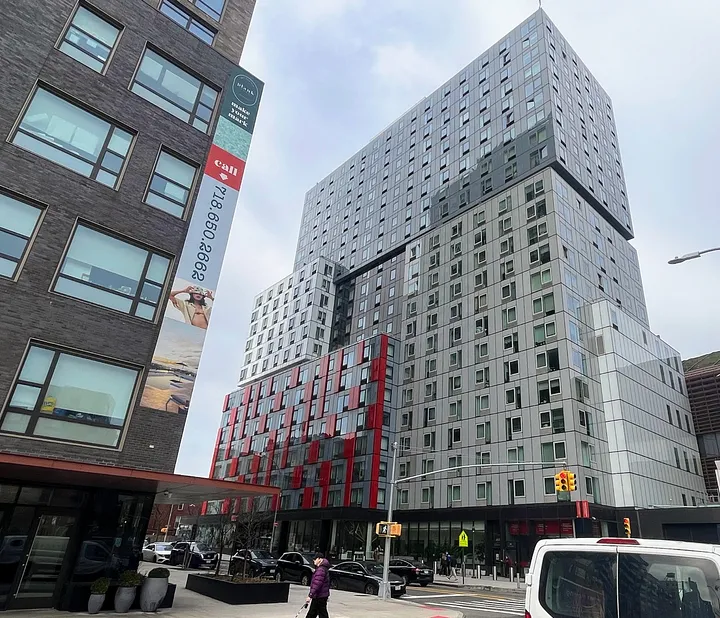 |
| Looking southwest toward 38 Sixth. Photo: Norman Oder |
Why would Avanath try to add riders in which tenants were required to sign away their rights to a class-action lawsuit, and to submit to mandatory arbitration? Well, such forms are used in some jurisdictions with more limited tenant rights.
One tenant told the TA that, while they tried to not sign the rider during lease renewal, Avanath insisted it was required, warning that tenants would be contacted by Avanath lawyers.
The DHCR’s fact sheet, however, says: “Renewal leases must keep the same terms and conditions as the expiring lease.”
After intervention by TakeRoot and the DHCR, according to the TA, Avanath backed off. On July 1, the landlord sent out a “Clarification Regarding (3) Lease Riders,” claiming they “were provided in error.”
The DHCR’s fact sheet, however, says: “Renewal leases must keep the same terms and conditions as the expiring lease.”
After intervention by TakeRoot and the DHCR, according to the TA, Avanath backed off. On July 1, the landlord sent out a “Clarification Regarding (3) Lease Riders,” claiming they “were provided in error.”
Lawsuit-shy?
One reason for the Class Action rider may have been that Avanath was sued last year by tenants in Washington DC building, 2M (now known as Affinity at 2M), in a class action.
Since December 2021, the residents—a mix of market-rate and subsidized units—of 2M Street NE in NoMa “have lived in unsafe, unclean, neglected, and chaotic conditions,” causing “physical and psychological harm, as well as financial injury,” according to the lawsuit, which also charges that the landlord has interfered with tenant organizing.
The lawsuit alleges a cascade of maintenance and operational horrors: mold, cockroaches, broken appliances, persistent plumbing issues, plus a lack of heat, air conditioning, and/or hot water.
Since December 2021, the residents—a mix of market-rate and subsidized units—of 2M Street NE in NoMa “have lived in unsafe, unclean, neglected, and chaotic conditions,” causing “physical and psychological harm, as well as financial injury,” according to the lawsuit, which also charges that the landlord has interfered with tenant organizing.
The lawsuit alleges a cascade of maintenance and operational horrors: mold, cockroaches, broken appliances, persistent plumbing issues, plus a lack of heat, air conditioning, and/or hot water.
 |
| Screenshot from Fox 5 DC |
(In a brief legal response, Avanath denied the allegations. Two mediation sessions led to a stalemate; the case will proceed later this summer.)
Also, as alleged: a malfunctioning garage door remained open for over a month, causing freezing air to enter the building and leading to cars being stolen and intruders entering.
The lawsuit cites break-ins, an escaped prisoner hiding out, unhoused people sleeping in trash rooms, and poor security. Residents "report multiple fatalities due to overdose in the building as well as prevalent use and sale of drugs in the building.”
As reported on Fox 5 DC last August, one resident set another resident's apartment door set on fire while the tenants were inside, but the assailant had not been removed from the building.
Contrasting reviews
As reported on Fox 5 DC last August, one resident set another resident's apartment door set on fire while the tenants were inside, but the assailant had not been removed from the building.
Contrasting reviews
If you go to 38 Sixth's Google reviews, the most recent review is one star, warning of “a roach infestation that’s been ongoing for years. Serious genuine lack of care from management.” (Open roach violations have been found at spots on nine floors.)
Meanwhile, the three previous reviews are positive. A five-star review praises "FREE events for educational purposes," a four-star one says “Any concerns I’ve had have been addressed.”
Another four-star one observes, “while the building definitely needs some TLC and isn't perfect—the resident services team tries her best to listen to concerns and address problems in a timely manner.”
 |
| Posting in 38 Sixth elevator; Photo: Norman Oder |
The seven reviews after that are brutal, citing such things as mold and hot water outages.
The positive reviews seem in spirit with a landlord solicitation, spotted in a building elevator, for resident testimonials about how “Resident Services have benefited your… overall residential experience.” Those submitting testimonials could enter into a raffle for a $25 gift card.
The positive reviews seem in spirit with a landlord solicitation, spotted in a building elevator, for resident testimonials about how “Resident Services have benefited your… overall residential experience.” Those submitting testimonials could enter into a raffle for a $25 gift card.
TA ramps up
The TA has tried to ramp up pressure on the landlord.
The TA has tried to ramp up pressure on the landlord.
A TA press release called on “academic, nonprofit, and real estate industry organizations to review the leadership roles of multiple senior executives at Avanath Capital Management,” citing “chronic neglect, legal violations, and recently substantiated government orders involving worsening building conditions under Avanath's management.”
“Avanath’s executives have publicly promoted a strategy of ‘streamlining operations’—a phrase that, in our lived experience," the TA said, "has translated into cost-cutting measures that result in dangerous, unhealthy, and unlawful living conditions for working families."
“Avanath’s executives have publicly promoted a strategy of ‘streamlining operations’—a phrase that, in our lived experience," the TA said, "has translated into cost-cutting measures that result in dangerous, unhealthy, and unlawful living conditions for working families."
Chapin said that building conditions have improved compared to last year, given the front door, hot water, and intercoms, as well as a working fob system: “However, there is always a constant pressure of new things happening... and need fixing, like the elevators.”
“Everything takes a long time, and they don’t communicate about it,” Shundi observed. "This is my home, and I really care about it, but it sometimes feels like we're doing their job for them."
“Everything takes a long time, and they don’t communicate about it,” Shundi observed. "This is my home, and I really care about it, but it sometimes feels like we're doing their job for them."
Comments
Post a Comment