With Cirrus/LCOR team finally in place, 10 months--and a mere $12M for absent affordable housing--toward a new plan. Big questions remain, but NYS is on board.
Atlantic Yards/Pacific Park, we learned yesterday, finally has the expected new development team, with a new deadline to develop an agreement and some limited payments to the state.
But deep questions remain about the contours of the remaining project and how an expensive platform would be paid for, much less details regarding that development team or future oversight and guarantees.
We do know, however, that the new joint venture has the backing, and pension fund money, from building trades unions, who surely will supply "build it now" testimony at public hearings.
It also has official endorsement--sans any publicly announced plans about timing, scope, and public concessions regarding the expected eight towers, infrastructure, and affordable units--from Empire State Development (ESD), the gubernatorially controlled state authority that oversees/shepherds the project.
Despite ESD denials, surely such plans have been discussed privately, because only assurances of state support would've encouraged the development team to step forward on a project with many looming unknowns. (The "contours" of their request have been expected.)
 |
| The approved plans surely will change |
“Brooklyn has waited long enough. While progress has been made – including the construction of more than 3,000 units of quality housing -- advancing the next phase of Atlantic Yards means delivering the additional affordable residential units, jobs, open space, and neighborhood amenities the area’s residents deserve,” said Empire State Development President, CEO & Commissioner Hope Knight. “Under Governor Hochul’s leadership, ESD is determined to move this project forward in partnership with the permitted developer to engage the community and get to work.”
Hochul, of course, is running for re-election and wants to be able to trumpet a win.
Emerging info on limited payment
The Real Deal yesterday was first with the news, reporting that the joint venture has agreed to pay $12 million, $4.5 million upfront, to a city affordable housing fund.
If the money, as the publication reported, "is intended to fill in for penalties"--$1.75 million/month, starting June 1--supposed to be imposed on master developer Greenland USA for failing to build 876 (of 2,250 required) affordable housing units, it's obviously a major discount, since the $4.5 million was eclipsed as of August 1.
 |
The penalties were negotiated in 2014 by the coalition BrooklynSpeaks, which has not yet commented on the deal.
Updated: In response to my query on Twitter/X, BrooklynSpeaks leader Gib Veconi stated that he was looking forward to learning more at the Atlantic Yards CDC meeting tomorrow. He's on the board.
He later told the Real Deal: “My biggest question, at this point, is how do we make sure the future isn’t like the past?” He added, “The timeline is important here. I really want to understand when the new team believes affordable apartments will come online. The longer that timeline is, the riskier the project becomes.”
I'd add that the longer the timeline, the more expensive the below-market units become, given that the baseline to calculate affordability continues to rise.
Asked how the penalties were calculated, ESD spokeswoman Emily Mijatovic told me, "The Governor and ESD required the joint venture to provide an affordable housing trust payment to support the near-term financing of affordable housing in the neighborhoods surrounding Atlantic Yards. The $12 million was part of a negotiation with the joint venture and does not reflect a specific period where liquidated damages payments would have accrued."
In other words, it's a token payment, suggesting that ESD felt it had to ask for something.
What about Greenland?
Keep in mind that Greenland, which should be liable for the full payment, is not walking away from the project.
Rather, as a junior partner, Greenland aims to monetize both the B1 parcel, the tower once slated to loom over the arena, and Site 5, the parcel across Flatbush Avenue, long home to the big-box stores P.C. Richard and the now-closed Modell's, temporarily home to BSE Global's new Brooklyn Basketball Training Center.
That would create a giant two-tower project at Site 5 that ESD has already blessed, though a new plan still would require a public approval process and vote by the gubernatorially controlled ESD board.

(Greenland will won't have a role in the B5-B10 sites, but while the U.S. Immigration Fund and Fortress Investment group, which are junior partners on those sites, won't have a role in B1/Site 5.)
Why should Greenland, as was suggested at the AY CDC meeting in August, be bailed out? Why couldn't the penalties be taken out of Greenland's remaining value?
New timing?
The Real Deal also reported that ESD has set a July 31, 2026 date, roughly ten months from now and 14 months past the affordable housing deadline, for a new memorandum of understanding outlining the project. presumably involving scope, concessions, and public benefits.
If that isn’t resolved by the deadline, ESD could then pursue the full $1.75 million a month damages. Then again, ESD suspended enforcement of the penalties and otherwise has accommodated developer requests, so another delay wouldn't be a shock.
Perhaps some questions will be answered tomorrow at a belatedly-scheduled meeting of the (purportedly) advisory Atlantic Yards Community Development Corporation (AY CDC), which clearly was announced only when the parent ESD knew that a foreclosure action, pending since November 2023, had finally been resolved.
The announcements
A not too informative press release yesterday, circulated yesterday by the lobbying firm Bolton-St. John's, was headlined "CIRRUS WORKFORCE HOUSING AND LCOR APPROVED BY EMPIRE STATE DEVELOPMENT AS CO-DEVELOPERS TO LEAD THE NEXT PHASE OF PACIFIC PARK TRANSFORMATION," with the subheading "Project Creates Thousands of Units of Housing with Union Labor."
For those with long memories, that sounds like the original project slogan, "Jobs, Housing, and Hoops," minus the basketball, since the Barclays Center arena has been built.
(Bolton-St. John's is being paid $20,000/month to lobby for Cirrus Workforce Housing Associates LLC.)
"To facilitate housing creation for hardworking New Yorkers," states the press release, "Cirrus restructured the project and is leading a joint venture with LCOR, U.S. Immigration Fund [USIF], Fortress Investment Group and Greenland to complete the development."
That doesn't tell us that much. Nor did complementary/competing announcements from the USIF and Fortress, which controlled debt that went into foreclosure after Greenland failed to pay off some $286 million (of an original $349 million) in loans from immigrant investors under the EB-5 investor visa program.
Who's in charge?
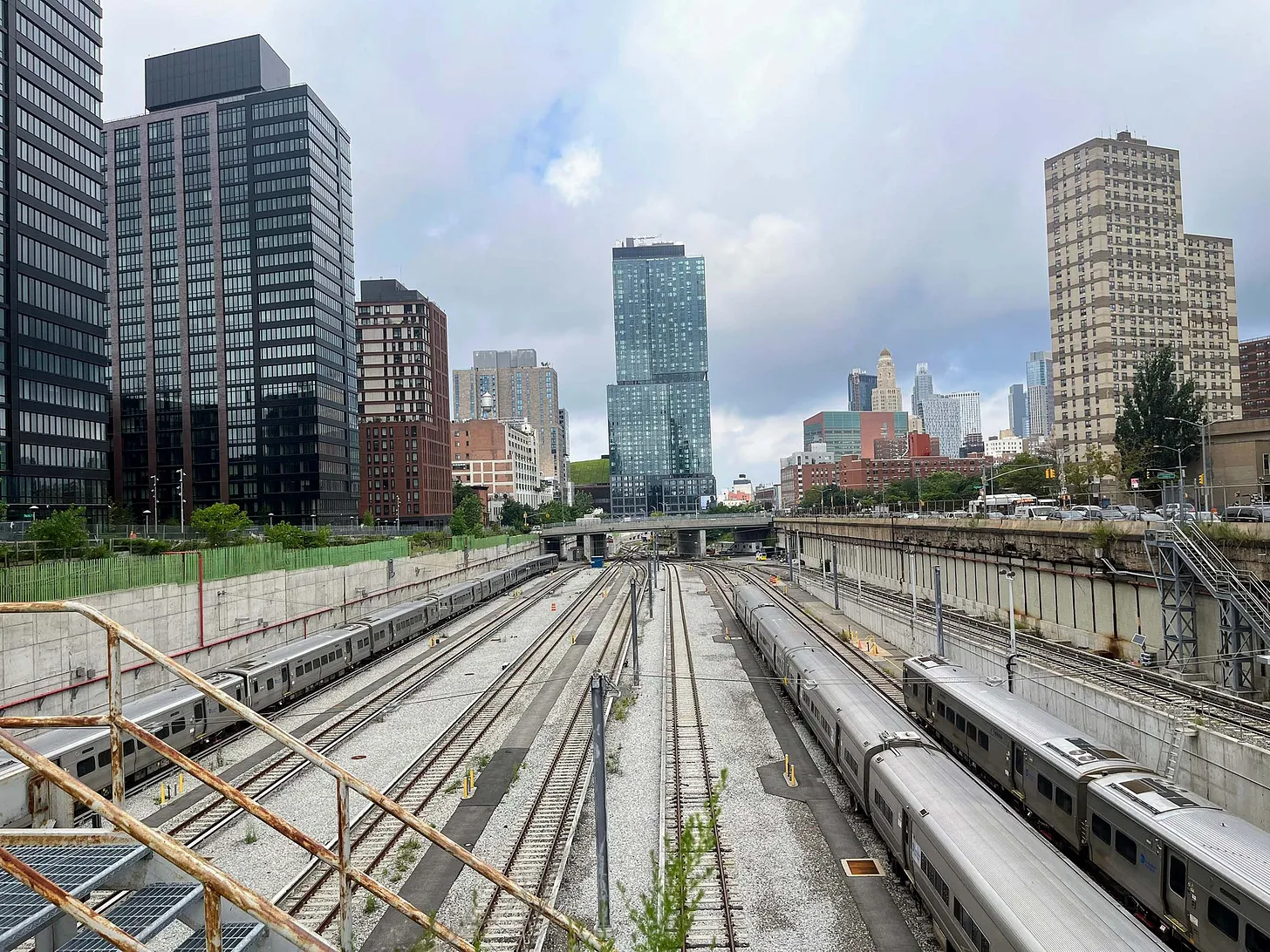
Greenland's collateral, which went into foreclosure, was an affiliate that had part of the development rights for the six towers (B5-B10) to be built over the two-block Metropolitan Transportation Authority's Vanderbilt Yard, used to store and service Long Island Rail Road trains, which require an expensive platform.
(Note that Hudson Yards developers recently managed the neat trick of getting the public to pay for the platform.)
Fortress, which acquired a share of the EB-5 debt, and USIF, as manager (and also progenitor of a related entity), were presumed by many observers, including me, as controlling the future of the railyard sites.
Instead Cirrus, which apparently acquired a different Greenland stake in the railyard sites, apparently related to embedded investment such as preliminary platform work, holds sway. But it's unclear what percentage each party owns, and how the ownership is structured. Perhaps we'll learn more.
Last year, Related Companies, developer of Hudson Yards, was exploring a takeover of the project. When they dropped out, Cirrus emerged. According to a USIF press release yesterday, "USIF and Fortress Investment Group (Fortress) select Cirrus and LCOR to lead the continued development of Pacific Park."
That's hardly certain, since Cirrus emerged first and presumably then found LCOR.
If "Cirrus restructured the project," according to its press release, the USIF said in its press release, "Through their strong relationships,persistence, and the financial restructuring efforts, USIF and Fortress entered into agreements with Cirrus and LCOR who have now been approved by ESD and the MTA as the replacement developers for the project."
Big questions
Did ESD have information, I asked yesterday, on how the platform would be paid for? What about the contours of the future development—for example, square footage and unit count? Would the developers get additional development rights free from MTA or have to pay for them?
I didn't get much of an answer.
"With ESD’s approval of the permitted developer and the completion of the foreclosure auction, the joint venture has taken on the responsibilities outlined in the existing project agreements," ESD's Mijatovic responded. "ESD has not yet reviewed any proposed plans, and any changes to the General Project Plan will be guided by community input and follow the required approval process."
While ESD plans a "community engagement" process and already has hired facilitator Karp Strategies, it's hardly clear how the community would be defined, and how community input would be measured, especially given enormous fatigue about the value of past public processes. ESD's track record suggests a reliance on developer needs, not community input.
Cirrus's role
Cirrus, according to the press release, "will serve in both a funding and co-developer capacity," though its lack of a decade of development experience--its leaders are funders and the firm is new--mean it could not have been chosen by ESD as a "permitted developer."
It recently announced an alliance with Resorts World to develop up to 50,000 units of "workforce housing" and, with LCOR, was awarded rights by the city to develop the former Flushing Airport site.
“Cirrus is a mission-driven organization that firmly believes housing should be built for the people who make New York City great," said Joseph McDonnell, Managing Partner, Cirrus Workforce Housing, in the press release. "We’re thrilled to step up and deliver thousands of units of sorely needed housing in a public-private partnership with LCOR, ESD, MTA and the Building and Construction Trades for the benefit of our stakeholders and community to help combat the housing crisis that currently exists in our city."
What's next?
Note the role of the MTA, which must be paid $11 million a year, through 2030, for previously negotiated vertical development rights. It's unclear whether the joint venture would have to pay for more bulk, though why should be public be asked to give away valuable vertical "land"?
In 2021-23, as I reported, Greenland proposed to rescue the project by supersizing it. A similar, or even larger, plan, could recur.
 |
| Greenland USA's proposals, which could recur |
LCOR, according to the press release, is a vertically integrated institutional developer and investment manager with more than four decades of experience developing complex, large-scale projects, including Terminal 4 at JFK and Hoboken Connect, a $900M mixed-use Transit Oriented Development project that is transforming the Hudson Waterfront with residential, retail, office, historic preservation and significant public infrastructure upgrades to Hoboken Terminal and the surrounding area.
How affordable?
The Cirrus press release stated that Pacific Park--are they keeping the name?--"will deliver thousands of apartments, including workforce and affordable housing, green space and other amenities that include community use, which serves the downtown Brooklyn community and beyond."
(They're back to Downtown Brooklyn, I guess, though the project is in Prospect Heights and separate from the downtown redevelopment.)
The number of below-market units, and their affordability, is of course unresolved. If the priority is more deeply affordable housing, as BrooklynSpeaks has proposed, that means advocates might endorse even larger towers. That of course was the original justification for a dramatic change in scale.
The "green space" would mean the completion of the eight-acre open space planned as "Pacific Park," of which less than three acres have been completed.
As to "community use," it wouldn't be surprising to see, at Site 5--where there's no room for green space--some sort of community amenity, as BrooklynSpeaks has proposed a "space for large community gatherings."
Cost and timing?
The Real Deal relied on the not always reliable USIF founder Nicholas Mastroianni II--note my coverage of misleading marketing--for estimates on timing and cost:
USIF’s Nick Mastroianni said he expects the plan to be reworked and finalized over the next year and half. The first phase, which involves building the first of two platforms over the rail yards, will cost an estimated $4 billion and take roughly five years to complete, he said. The second phase will cost another $2 billion. He said the development team has “ideas on how to bring the affordable housing to reality sooner rather than later,” but wouldn’t share details on what the team envisions for the site. He noted that some of the sites--[I think only the B5 site] will qualify for the now-expired property tax break 421a.It's hard to believe that the first phase would cost $4 billion, since the first platform--long assumed to be the block between Atlantic Avenue and Pacific Street, and Sixth and Carlton avenues--should be less complicated and less costly than the second one, between Carlton and Vanderbilt avenues.
(As of 2018, at least, platform costs were estimated at least $192 million, plus an additional $50+ million set of payments to assist with Long Island Rail Road operations.)
The more expensive the project, especially the infrastructure, the more the argument for public support and or additional development rights.
As of mid-2022, Greenland was aiming to start the platform. But that plan ran aground after protracted negotiations with the ESD and MTA, and the expiration of the 421-a tax break.
Comments
Post a Comment