Crossroads Brooklyn: Urban Design is tonight. Let's look at principles, including "slow streets" (+ arena parking), reducing municipal uses (?), and the (unspoken) scope of Site 5
"The BrooklynSpeaks Crossroads series invites the public to envision a plan for future development at Atlantic Yards," according to the BrooklynSpeaks coalition, though--as I've written--a lot of the "asks" have already been announced.

The principles
Let's take a quick look at the updated BrooklynSpeaks Urban Design principles, under the rubric "1. Respect and integrate with surrounding neighborhoods."
Note that, due to changed circumstances, this differs vastly from the previous iteration of those principles, which:
- as of 2009 warned about "a massive surface parking lot," and called for programming "interim active and passive open space on unused areas," among other things, and
- as of 2006 called for the project size to "be substantially reduced," to "[c]reate public parks that feel public," adjacent to streets rather than behind buildings, and to reuse "existing buildings such as the historic Ward Bakery."
The principles
Much of what's in the document is unobjectionable and/or worthy, though it's worth pointing out certain gaps, as well as a contradiction/irony.
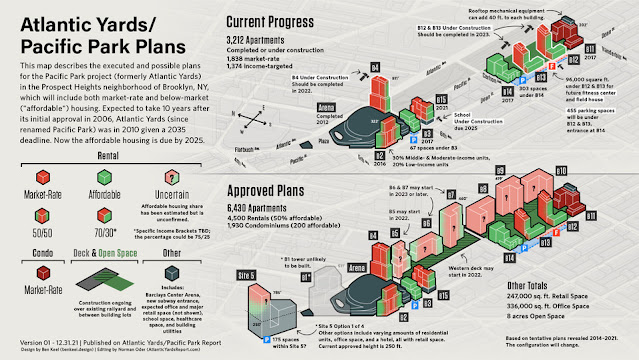
Also, it's focused mainly on plans for a giant, two-tower project at Site 5, though it's certainly possible that development over the railyard could start, and deserves attention.
 |
| From developer's 2016 presentation to Department of City Planning. The open space (arena plaza, Times Plaza) isn't green, but Brooklyn Bear's Garden is next to Site 5, though not visible. |
"Slow streets" and project parking
From the document:
As Brooklyn’s biggest development project situated between the borough’s densest corridor and low-scale brownstone neighborhoods, Atlantic Yards has a responsibility to ensure a transition not only of scale and density, but also of traffic and street and sidewalk utilization. The State and the City must work together to foster a safe environment that reflects sound principles of urban design.(Emphases added)
In consultation with the community, NYC DOT should redesign Dean Street between Sixth Avenue and Vanderbilt Avenue, and Pacific Street between Flatbush Avenue and Fourth Avenue, to make each a slow street intended for local use.
No definition or example of "slow street" is offered, but slow streets limiting cars have been proposed for Lower Manhattan, and John Massengale, an advisor to BrooklynSpeaks, is behind that.
The problem is that Dean Street is already congested by vehicles entering the 303-space parking garage just east of Carlton Avenue, especially on event nights, and it's likely to be more congested when that garage is expanded to 758 spaces.
Reducing municipal uses
From the document:
In consultation with the community, following the opening of the school at building B15, the City must prepare a plan for ensuring student and pedestrian safety at the intersection of Dean Street and Sixth Avenue, including a reduction of municipal uses at that location.That implies limiting/eliminating on-street parking by NYPD and FDNY personnel, and/or moving the fire and/or police stations. (The FDNY station could be... a development site?)
The irony is that some of the prime movers behind BrooklynSpeaks advocated for a middle-school at B15 (aka Plank Road, 662 Pacific St.), while others, including Community Board 2, suggested a less congested location.
Site 5 design
From the document:
Buildings developed at Site 5 (the block bounded by Atlantic Avenue, Flatbush Avenue, Pacific Street and Fourth Avenue) should be set back from Pacific Street, with a building or building section contextual to the row houses on the south side of the street buffering towers from the residential context.
Ground floor space along Atlantic Avenue, Fourth Avenue and Flatbush Avenue must be designed with large windows providing visibility from the street to active uses inside the building (including retail, community, and non-profit tenants). Static window displays obscuring activity inside the buildings should be avoided.
Sure, it makes sense to try to buffer low-rise Pacific Street from a tower rising some 800 feet, and to ensure that ground-floor space has visibility--though presumably the latter also makes sense for business reasons, especially for higher-end retail.
But the statement punts on the big question of how big the Site 5 project should/could be. Is a full buildout OK as long as it delivers additional lower-income affordable housing? Is that the right tradeoff?
Pacific Branch library as landmark
From the document:
The City should designate the Pacific Branch Library a New York City landmark, and the State should add it to its register of historic places, to ensure it is both preserved and receives the necessary protections from the impacts of Site 5 construction. Funding must be provided for necessary renovations and upgrades, including technology.
Sure, that building, sandwiched in between Site 5 and a 15-story development project (see below), deserves protection. But the state process for approval of Site 5 couldn't directly lead to the city designation, though of course it's possible for city and state to work together.
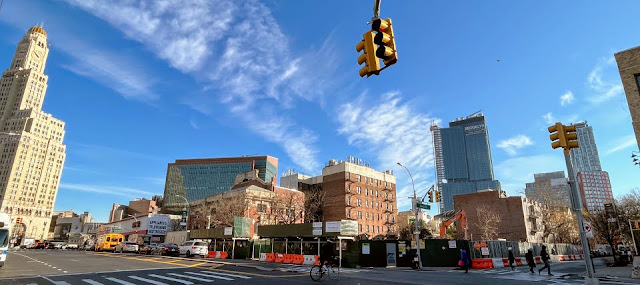 |
| Library center-left, between Site 5 and new development site |
From a 2019 session
BrooklynSpeaks held an October 2019 public meeting on the project. Here's their summary of the Urban Design session:
Respect and integrate with surrounding neighborhoods(Emphasis added)
This discussion was led by John Massengale, Chair of the Center for New Urbanism, New York City, and James Ellis, Executive Director of the North Flatbush BID. Participants suggested design strategies to make Atlantic Yards’ large buildings and the spaces around them more inviting, like providing green spaces both around buildings and also inside them, and creating temporary markets for local vendors. Ground floor spaces should be open to visibility from the street. Dean Street should be redesigned as a quiet local street, perhaps including relocation of the firehouse entrance. Technology that could manipulate sunlight to counter the effect of shadows from large buildings should be explored.
Group members saw an opportunity for more active and passive open space in the neighborhood, including basketball courts and playgrounds with space for toddlers. An interest in having the project fulfill its commitment to provide an “urban room” or public atrium was expressed, with some participants suggesting Atlantic Yards also include a municipal or community meeting space.
Providing parking for bicycles at schools in the project buildings was discussed. There were mixed opinions about the amount of off-street garage parking that was optimal for the project. Participants agreed that encouraging more pedestrian use was important, perhaps including interior pathways between buildings.
I hadn't noticed that Dean Street mention previously.
Comments
Post a Comment