Construction union advocates need a better example than Atlantic Yards to highlight less costly development projects
An article in THE CITY today, by contributor (and former Crain's New York Business editor and columnist, if you're wondering about any slant) Greg David, Can Mamdani Make Union-Built Affordable Housing Add Up?, notes that Democratic mayoral nominee Zohran Mamdani has avoided weighing in on three controversial ballot proposals because he doesn't want to tangle with construction unions, which oppose them.
The issues are nuanced and complicated--I'll point to more of the debate in a separate post--but it is true that union labor pays higher wages, and union advocates would like the City Council to retain power, in part to ensure a union presence.
Do higher wages make projects more costly? One argument for union labor is that it's higher quality, thus enabling faster, more effective construction.
Here's the argument ventilated in the article, though:
Anyone claiming that higher priced union workers makes the projects too costly is “a lying silly goose,” said Kevin Elkins, political director of the NYC District Council of Carpenters. He points to apartments built at Atlantic Yards and a joint venture between the building trades and the real estate fund Cirrus to build affordable housing.
Atlantic Yards, really? This is an example of what I call "Atlantic Yards down the memory hole."
The Atlantic Yards example
Remember how developer Bruce Ratner, in 2011 promoting his plan for lower-cost modular housing, told the Wall Street Journal that his promised affordability plan—2,250 below-market rentals—couldn't "work for a high-rise building that's union built."
But that’s what Ratner promised, in part to gain support from construction unions in the state approval process for the megaproject.
But that’s what Ratner promised, in part to gain support from construction unions in the state approval process for the megaproject.
They tried modular construction, with lower wages in the factory. It failed. Then they sold 70% of the project, going forward, to Greenland USA, which later acquired the remaining 25%.
Yes, they used union labor, but the affordable housing--after three buildings that relied one extra city help--in four towers was only for middle-income households, as permitted by the 421-a tax break.
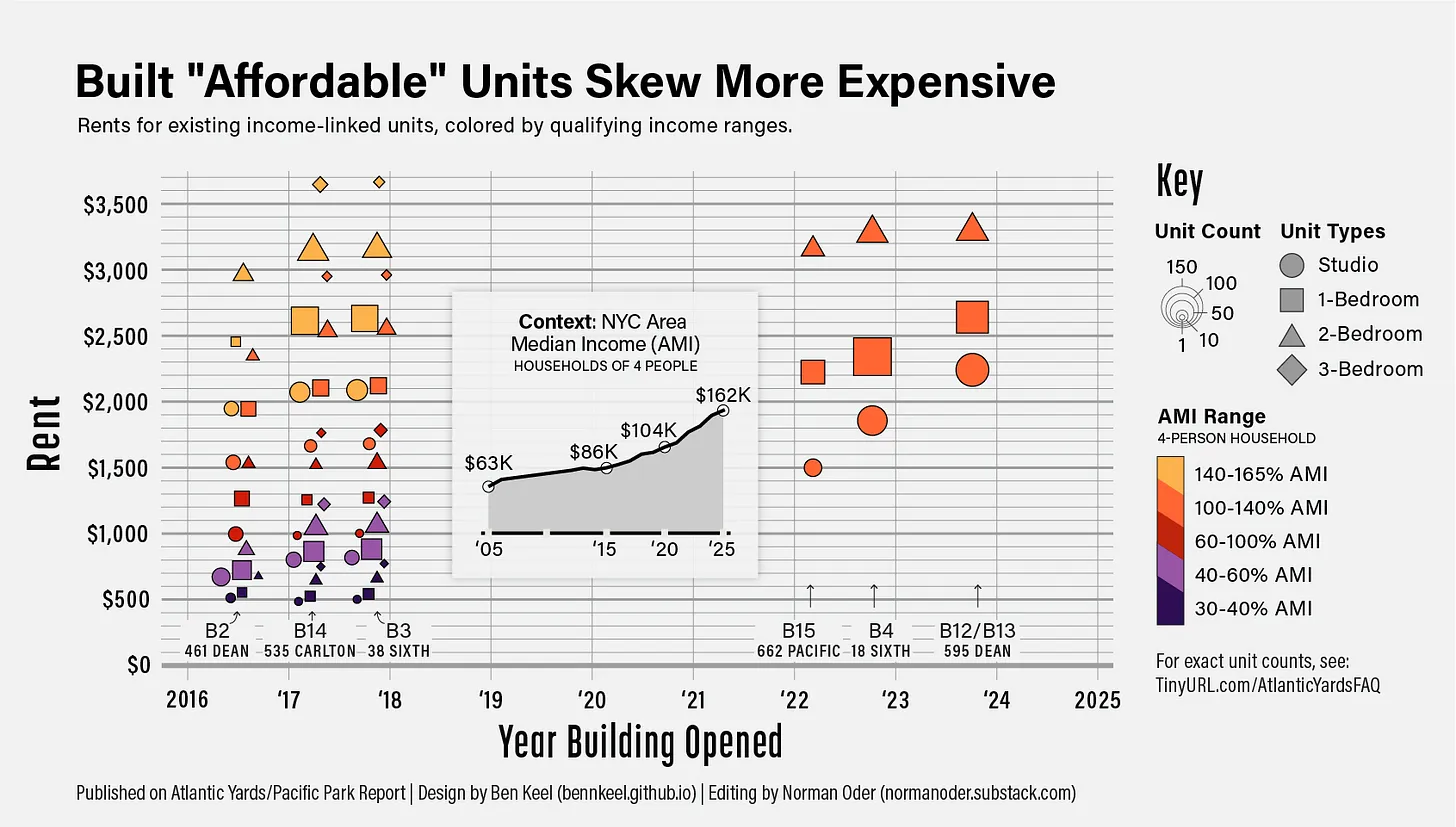
New unknowns
Greenland has since lost control of the project in a foreclosure proceeding, with Cirrus and its joint venture partner LCOR now in charge. A new plan awaits.
Yes, Cirrus has some momentum, given that it and its partner LCOR were awarded the Flushing Airport development site. Still, they haven't built anything, so we don't know the project configuration.
With Atlantic Yards/Pacific Park, union labor may now be a positive factor: the support of pension fund money and a project labor agreement to regularize costs.
However, the affordability levels, and overall project viability surely will depend on new concessions from the state and the city to make the numbers work. As of now, those remain major unknowns.
Comments
Post a Comment